

Last Updated: 14 November 2026
Quick Summary
Modernising workplace amenities with vending means putting drinks and snacks within a few steps of staff’s desks, usually through a fully managed service. Modern machines add cashless payment, remote stock alerts and healthier or fresh options, while the supplier handles restocking and repairs under an agreed arrangement.
- Convenient on-site refreshments can reduce off-site breaks, which can take a considerable part of the working day.
- Modern machines offer contactless payment, remote stock alerts and fresh food, unlike traditional coin-operated machines.
- Write restocking frequency and fault response times into the agreement, because you depend on the supplier’s service levels.
- Compare total cost over the contract period, since a low headline fee can hide call-out charges and minimum stock commitments.
- Survey staff before installing, as skipping employee research is the most common reason a new machine underperforms.
Table of Contents
- Why Workplace Vending Matters for Staff Satisfaction and Productivity
- Workplace Vending Solutions: Traditional Machines Compared With Modern Options
- Managed Vending Services and Smart Vending Machines: Pros, Cons and Costs
- Booking a Site Assessment and Your First Managed Vending Installation
- Frequently Asked Questions
Why Workplace Vending Matters for Staff Satisfaction and Productivity
Modernising workplace amenities with vending is one of the simplest ways to improve daily working life. Fully managed vending can put a drink or snack within a few steps of staff’s desks, making workplace amenities a practical everyday benefit.
Convenient refreshments on site can reduce off-site breaks, which for many people can take a considerable part of the working day. Good food and drink on site can also support morale.
Watch out: an empty machine on a busy afternoon undoes the benefit quickly. Choose a supplier that restocks on a schedule you can rely on.
Workplace Vending Solutions: Traditional Machines Compared With Modern Options
Traditional vending machines dispense a fixed range through a coin or card slot. They suit basic needs, but stock is often generic and restocking depends on manual checks.
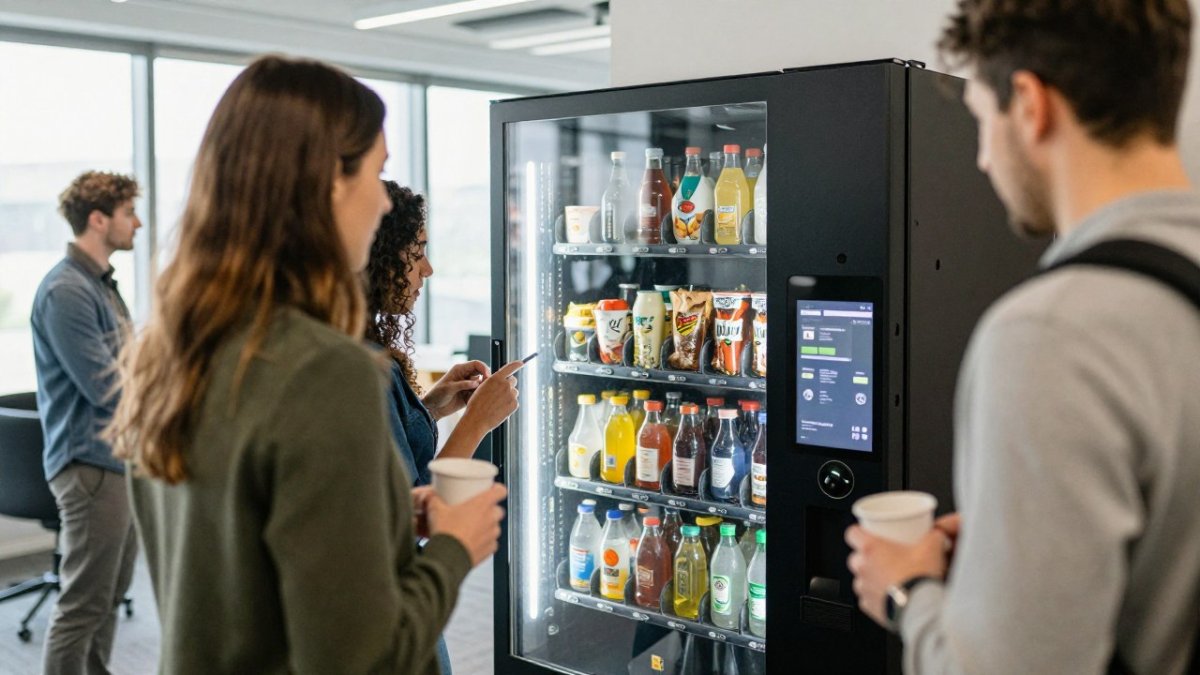
Modern options often add cashless payment, touchscreen selection and remote monitoring, so suppliers can see when a machine is running low, and some offer fresh food and healthier choices.
| Feature | Traditional machine | Modern machine |
|---|---|---|
| Payment | Coins or notes | Contactless and card |
| Stock monitoring | Manual checks | Remote alerts |
| Product range | Fixed, mostly snacks | Fresh food, hot drinks, healthier options |
Best for: Traditional machines suit small sites with simple needs. Skip if: you want a varied, healthier range.
Managed Vending Services and Smart Vending Machines: Pros, Cons and Costs
A fully managed service generally takes the operational burden off a facilities team, with the supplier typically handling the range, restocking and repairs under an agreed arrangement. Smart machines can add telemetry such as cashless transaction data and stock levels, so replenishment can be guided by what is selling.
The trade-offs are real. You become dependent on the supplier’s service levels, so response times and replenishment frequency need to be written into the agreement. Smart machines can also carry a higher unit cost and need reliable power and data. Where footfall is low, a well-stocked traditional machine can be the more sensible choice.
Workplace vending is commonly arranged under a few commercial models. Under a fully managed, subsidised arrangement the employer may pay a fixed fee, with staff buying products at a set price. Under a commission or profit-share arrangement the operator may pay the site a percentage of sales. Under a direct-purchase arrangement the employer buys or leases the machine and pays for stock and servicing separately. Pricing depends on machine type, product range, delivery frequency and site access, so ask The FM Taste for a written quote through its website.
Service-level expectations are worth making explicit in any agreement, covering contact arrangements, restocking frequency, fault response and product date checks. Ask potential suppliers how they handle out-of-hours failures and whether they provide access to usage data.
Measuring whether the amenity is working is where most procurements fall short. Useful measures include usage per machine, sell-through by product, availability, waste from date-expired stock, and staff satisfaction through a short periodic survey, compared against the running cost. If availability is consistently low or waste is high, adjust the range or replenishment schedule, far easier when the data is in the contract from day one.
Watch out: a low headline fee can hide call-out charges and minimum stock commitments, so compare total cost over the contract period rather than the headline figure.
Booking a Site Assessment and Your First Managed Vending Installation
A site assessment turns a generic vending proposal into a workable plan. Work through a short sequence: understand what staff actually want, assess the space and services, select the supplier and format, install, then review after the first few weeks. That order avoids the common outcome of a machine in the wrong place stocked with the wrong products.
1. Employee research. A short anonymous survey or a handful of floor-walk conversations can tell you a great deal about what staff want. Ask about dietary requirements and allergens, preferred price points, the times of day people want refreshments, and whether they would use fresh food or only ambient snacks. Include shift-based and hybrid teams explicitly, a machine planned around a nine-to-five office will fail a site that runs early and late shifts. The same conversations can clarify whether coffee should be part of the refreshment offer, since an office coffee program needs to suit staff routines and dietary needs as closely as the snacks do.
2. Site assessment. Look at footfall by area and by hour, the space available (including door swing, approach and queuing room), power sockets, data or Wi-Fi coverage for smart machines, and access for restocking. Kitchens, breakout areas and shared corridors usually work better than isolated corners, because visibility drives use. For hybrid teams, place machines where the people in on any given day will pass them, and consider out-of-hours access for shift workers who cannot reach a canteen.
3. Accessibility and inclusion. Check that the machine controls, payment reader and product retrieval point are reachable from a seated position, that labelling is clear and legible, and that allergen information is easy to find before purchase. Offering a spread of price points and a range of dietary options (gluten-free, dairy-free, vegetarian and vegan) helps every member of the team.
4. Supplier selection. Compare more than price: ask about restocking frequency, fault response times, access to usage data, recall procedures, sustainability credentials (packaging, recycling and food-waste policy) and whether the range can be tailored to your survey results. Request a written quote that separates machine, stock, servicing and call-out costs.
5. Installation and launch. Agree the product range and restocking schedule in advance, confirm the installation date and any building access requirements, and brief staff on what is available and how to pay. A short launch communication noticeably improves first-month usage.
6. Review. After four to six weeks, check usage, availability, waste and satisfaction, and adjust the range or schedule. A quarterly review keeps the amenity aligned with a changing workforce.
To arrange a visit, contact The FM Taste through its website to request a site assessment and a quote for your workplace.
Watch out: skipping the employee research step is the most common reason a new machine underperforms in its first month, staff simply do not buy what is stocked.
Frequently Asked Questions
How can vending improve workplace amenities?
Vending gives staff quick access to snacks, hot drinks and fresh food without leaving the building. This reduces the time people spend off-site for refreshments and helps teams feel better looked after. A well-stocked range that reflects what staff actually buy makes the amenity feel relevant. Pricing depends on machine numbers, product range, delivery frequency and site size, so ask The FM Taste for a tailored quote on its website.
Is a managed vending service worth it for a team of around 60 people?
For a team of around 60, the value usually comes from reliability rather than volume. A managed service is designed to take on restocking, servicing and fault repairs, so staff are less likely to be left with empty machines. Compare the time your office manager spends chasing supplies with the cost of the service. Costs vary with product range, number of machines and visit frequency, so request a quote for your specific site before deciding.
What is the difference between vending and an on-site café?
A vending solution needs no staffing, kitchen space or daily food preparation, which makes it simpler to run than an on-site café. Vending suits sites that want consistent availability with low upkeep. An on-site café offers freshly prepared meals and more social space but carries higher staffing and running costs. Vending can suit out-of-hours and shift-based needs where a café would not be practical.


